
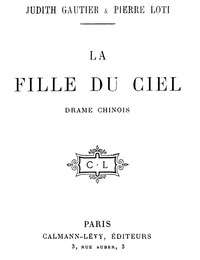
La fille du ciel: Drame Chinois by Judith Gautier and Pierre Loti
This book is a unique piece of work. It's a play written by two French authors—Judith Gautier and Pierre Loti—in 1911, imagining a fictional encounter during a very real historical moment.
The Story
The story is set in Beijing's Forbidden City in 1900, as the Boxer Rebellion rages outside the walls. The Empress Dowager Cixi, one of the most powerful women in Chinese history, is trapped in her palace, a symbol of a crumbling empire. Into this tense atmosphere comes a French naval officer named... Pierre Loti. Yes, the author puts himself in the play. He's captured and brought before the Empress. What follows is a series of intense conversations. He's mesmerized by her, by her power, her intelligence, and her profound loneliness. She, in turn, is intrigued by this foreigner who seems to see her not just as a ruler, but as a woman. Their dialogue is a dance of curiosity, cultural clash, and a fragile, impossible connection built on the edge of a knife.
Why You Should Read It
First, forget everything you know about dry history plays. This feels personal and immediate, probably because Loti wrote himself into it. The central relationship is fascinating because it's so unbalanced and built on illusions. Is Loti in love with the Empress, or with his own romantic idea of the 'Orient'? The Empress is a fantastic character—proud, sharp, and painfully aware of her gilded cage. The play doesn't give easy answers. It sits in that uncomfortable space where attraction and appropriation might overlap. It's a snapshot of a specific time when the West was obsessed with 'discovering' the East, and this story turns that obsession into a personal, dramatic confrontation.
Final Verdict
This is a niche but gripping read. It's perfect for anyone interested in late 19th-century history, cross-cultural encounters, or unconventional love stories. If you've read things like Memoirs of a Geisha or The Last Empress and wondered about the Western gaze within those stories, this is a raw, early example of that dynamic, written by the people living it. It's also short—you can read it in an afternoon—but it will stick with you, making you question where admiration ends and fantasy begins.
This publication is available for unrestricted use. Distribute this work to help spread literacy.
Carol Sanchez
6 months agoThis is one of those stories where it provides a comprehensive overview perfect for everyone. This story will stay with me.
George Lewis
1 year agoThanks for the recommendation.
Steven Lee
1 year agoThe index links actually work, which is rare!










Amanda Hernandez
3 months agoThe fonts used are very comfortable for long reading sessions.