
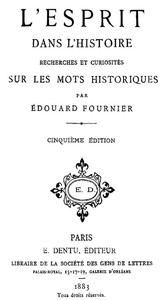
L'esprit dans l'histoire: Recherches et curiosités sur les mots historiques
Okay, let's clear something up right away: this isn't a novel. There's no single plot with a beginning, middle, and end. Instead, think of Edouard Fournier's L'esprit dans l'histoire (which translates to 'The Wit in History') as a massive, fascinating scavenger hunt. The 'story' is Fournier's own quest. He's bothered by all the catchy phrases and famous one-liners attributed to historical figures. His mission? To track them down and see if they're legit.
The Story
Fournier organizes his hunt by theme and era, looking at quotes from French history and beyond. He picks a famous line—like 'I am the state' (Louis XIV) or something a revolutionary might have shouted—and then he goes digging. He consults memoirs, official records, contemporary newspapers, and even popular songs from the time. Often, he finds that the perfect, punchy quote we know today was never said that way, or was said by someone else entirely, or just slowly morphed in the public imagination. The 'plot' is watching him debunk myths and occasionally confirm truths, revealing how legends are built one misremembered word at a time.
Why You Should Read It
This book completely changed how I read history. It made me a skeptic in the best way. Fournier isn't a stuffy academic; he writes with the curiosity of a detective who's genuinely excited (or frustrated!) by what he finds. You feel his 'Aha!' moments when he finds an earlier source, or his shrug when the evidence just isn't there. It’s less about memorizing dates and more about understanding how history gets made—and remade—through storytelling. It gives you this powerful tool: the question 'Says who?'
Final Verdict
Perfect for history buffs who are tired of the same old narratives, or for anyone who loves trivia, language, and a good myth-busting session. It's also great for writers, to see how phrases evolve. Because it's from the 1800s, the style is classic but clear, and the thrill of the chase is totally modern. Just be prepared—you'll never trust a quote in a movie or a textbook again without wondering, 'I bet Fournier would have something to say about that.'
This is a copyright-free edition. Share knowledge freely with the world.
Donna Wright
11 months agoJust what I was looking for.
Ava Martinez
1 year agoRead this on my tablet, looks great.
Christopher Scott
1 month agoI have to admit, it provides a comprehensive overview perfect for everyone. I would gladly recommend this title.






Charles Lee
9 months agoTo be perfectly clear, the clarity of the writing makes this accessible. I would gladly recommend this title.