
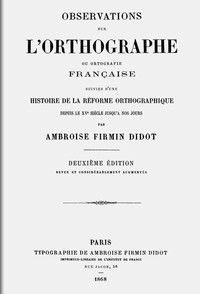
Observations sur l'orthographe ou ortografie française, suivies d'une histoire…
Let's set the scene: France, 1868. The country has seen empires rise and fall, but one battle rages on in parlors and printing houses—the war over French spelling. Enter Ambroise Firmin-Didot, scion of the legendary Didot publishing family. His book isn't a sterile manual; it's a manifesto. He lays out, with the precision of a master typesetter and the frustration of a lifelong reader, every absurdity in the French writing system. Why so many silent letters? Why do sounds have multiple spellings? He points out the inconsistencies with the sharp eye of someone who has literally set them in lead type.
The Story
There isn't a plot in the traditional sense, but there is a clear narrative arc. Firmin-Didot first methodically catalogs the problems—the superfluous letters, the illogical rules—making a compelling case that French spelling is needlessly complex. He argues for simplification, for spelling that actually reflects how people speak. The second half of the book is where it gets fascinating. He traces the entire history of this debate, showing how spelling has been a political and cultural football for generations. You see scholars, kings, and institutions all trying to pin down a system that, by its nature, keeps evolving. It's the story of a language trying to define itself on the page.
Why You Should Read It
You might think, 'A book about 19th-century spelling reform? Hard pass.' But trust me, it's weirdly gripping. Firmin-Didot's voice comes through clearly—he's witty, exasperated, and deeply knowledgeable. Reading it feels like listening to a brilliant, slightly pedantic friend explain a centuries-old inside joke. It completely reframes how you see language. Every quirky spelling rule in French (or English, for that matter) isn't just random; it's a fossilized remnant of old arguments, prestige, and tradition. It makes you realize that the way we write is never settled; it's always a negotiation.
Final Verdict
This book is a hidden gem for a specific kind of reader. It's perfect for language lovers, history nerds, and anyone who enjoys seeing how passionate people can get about seemingly mundane topics. If you're learning French and want to know *why* it's so hard to spell, this is your origin story. It's not a light beach read, but for the curious mind, it's a delightful and insightful window into a debate that is, in many ways, still alive today. You'll never look at a dictionary the same way again.
This masterpiece is free from copyright limitations. Distribute this work to help spread literacy.
William Lee
11 months agoA bit long but worth it.
Dorothy Martinez
1 year agoAs someone who reads a lot, the flow of the text seems very fluid. One of the best books I've read this year.
Richard Miller
10 months agoThanks for the recommendation.
Lucas Wilson
1 year agoA must-have for anyone studying this subject.




Mason Johnson
4 months agoHonestly, the emotional weight of the story is balanced perfectly. Worth every second.