
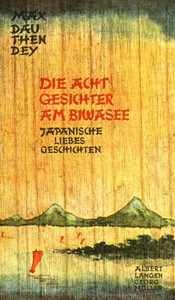
Die acht Gesichter am Biwasee: Japanische Liebesgeschichten by Max Dauthendey
Max Dauthendey's 'The Eight Faces at Lake Biwa' is a unique time capsule. A German poet and painter deeply infatuated with Japan, Dauthendey never actually visited the country. Instead, he immersed himself in its art and literature, and from that study, he spun eight fictional love stories, all connected by the serene yet symbolic setting of Lake Biwa.
The Story
Don't expect one continuous plot. Think of this book as a series of eight beautiful, standalone postcards. Each "face" is a different tale of love—sometimes passionate, often restrained, and always intertwined with the natural world of Japan. You might meet star-crossed lovers, couples bound by silent understanding, or individuals wrestling with duty versus desire. The lake itself is almost a character, its calm surface reflecting the often turbulent emotions within the stories. Dauthendey paints scenes of cherry blossoms, moonlit shores, and quiet interiors, using this backdrop to explore the subtle, unspoken rules of Japanese society and the heart.
Why You Should Read It
What makes this book so compelling isn't just the stories themselves, but the perspective behind them. You're not reading a Japanese author explaining his culture. You're reading a European romantic imagining it. This creates a fascinating layer. His love for Japan is palpable and sincere, yet you can sometimes feel the slight distance, the interpretation. The prose is lyrical and gentle, perfect for slow reading. It’s less about dramatic plot twists and more about capturing a feeling—a mood of melancholy beauty, of love expressed through a glance or a shared silence rather than a grand declaration. It feels like listening to a well-loved piece of music from another era.
Final Verdict
This book is perfect for readers who love atmospheric short stories, have an interest in Meiji-era Japan, or enjoy seeing how one culture views another through art. It's for anyone who appreciates quiet, character-driven writing over fast-paced action. If you go in knowing it's a European's poetic tribute—not an authentic Japanese document—you'll be swept away by its dreamlike charm. A short, serene, and thought-provoking escape.
This book is widely considered to be in the public domain. You do not need permission to reproduce this work.









Betty Torres
3 months agoFast paced, good book.